

Replacing worn outdoor cushions should be simple, yet most patio cushion orders go wrong because of one bad number. A cushion that is too small slides around inside the frame, and a cushion that is too large bulges and splits its seams. The good news: measuring a cushion correctly takes a few minutes and requires no special skills. This guide explains exactly how to measure outdoor cushions, including seat cushions, back cushions, throw pillows, rounded corners, and furniture frames, plus how much extra to allow for seams, zippers, and real-world fit.
I have measured and replaced dozens of outdoor cushions over the years, so these are the steps I still use every time.
Why Accurate Measurements Matter
Outdoor cushions rarely keep their original shape. Foam compresses, fabric relaxes, and zippers distort after a season or two of sun and rain. If you copy the dimensions of an old, sagging cushion, your replacement will look undersized almost immediately. You can also read our guide on how to protect outdoor cushions.
Measurements should describe the cushion you want, not the tired cushion in front of you. That is why the best approach is to measure the foam core if possible, or the cushion seams if the cover is sewn shut. Then compare your numbers against the vendor's own size chart before you order.
The same principle applies to indoor surfaces: support only works when the surface matches the body using it. That is why our practical sleep guidance is built around choosing a supportive surface rather than simply buying the softest option. For more on this, see our guide on how to measure replacement outdoor cushions.
Tools and Preparation
You do not need a workshop. For accurate measurements, gather:
- Flexible fabric tape measure
- Straight ruler or yardstick
- Notebook, phone, or a printed order form
- Carpenter's square or angle finder for frames
- Soft brush to remove dirt and sand
Use a cloth tape measure, not a metal construction tape. A metal tape will not bend around curved cushion edges, and its hook end can throw off a reading by a quarter inch.
Lay the cushion flat on a table, bench, or clean floor. Let it settle into its natural shape. Brush away any debris, especially at the seams, so the tape sits evenly. If the cover has a zipper, remove it and measure the foam core directly. If you cannot remove the cover, measure from seam to seam rather than over the puffy center. For more on this, see our guide on how to keep outdoor cushions from sliding.
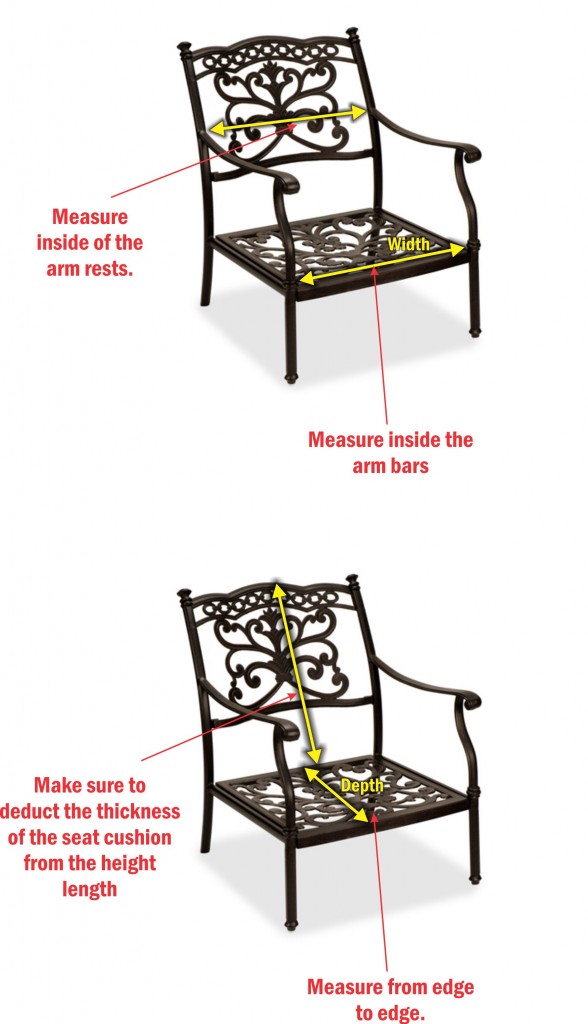
Image source: onlinereplacementcushions.com
How to Measure Seat Cushions Step by Step
Seat cushions carry the most weight, so width and depth deserve extra care. Measure in this order:
- Width: Measure left to right across the widest point, keeping the tape flat against the seam. If the front edge curves, measure across the front and across the back, then record the larger number.
- Depth: Measure front to back through the center. Do not follow the curved side edge.
- Thickness: Measure from the bottom seam to the top seam at the center of the cushion. Avoid measuring at the piping, where the cover can add extra height.
- Shape details: Note whether the corners are square, rounded, or tapered, and whether the cushion has piping, tufting, a flange, or a hidden zipper.
If the cushion is hinged, such as a chaise cushion that folds in the middle, open it flat and measure each section separately. Never stretch the tape across the hinge, because the hinge adds fabric that will distort the true dimensions.
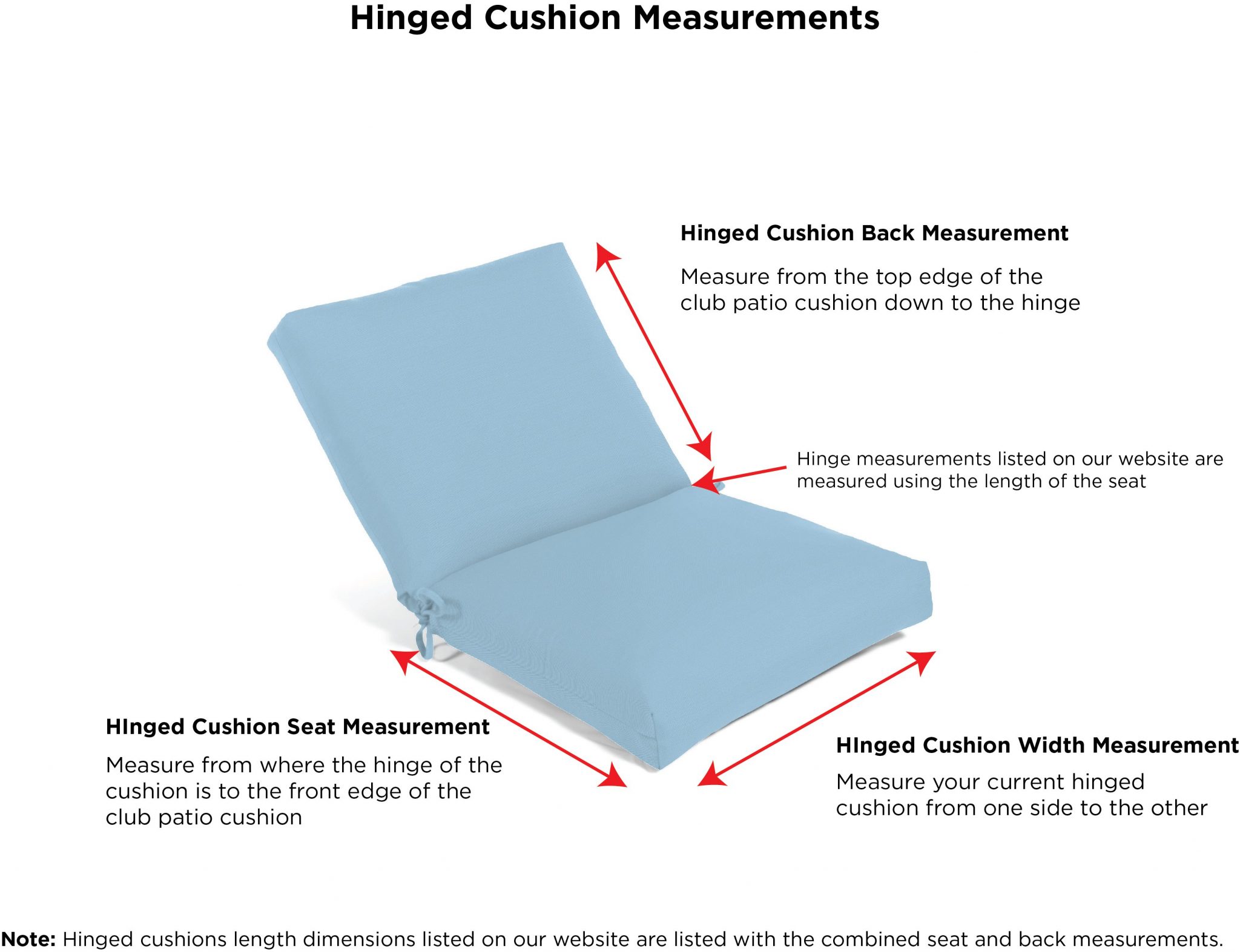
Image source: cushionconnection.com
How to Measure Back Cushions and Throw Pillows
Back cushions and throw pillows are lighter and more forgiving, but shape still matters. Use the same width and height logic, with a few adjustments:
- For a rectangular back cushion, measure width and height.
- For a lumbar cushion, measure the length and the height at the center.
- For a loose throw pillow, measure across the face and the depth from seam to seam.
- For a boxed back cushion, measure the depth of the side gusset as a separate number.
Many people forget the gusset, the strip of fabric between the front and back faces. It adds real volume and affects whether a replacement looks plump or flat. Include it in your order notes. For more on this, see our guide on how to dry outdoor cushions.
If your back cushion has a flange or a welt cord, record that too. I once ordered replacement backs without noting the flange, and every cushion came back visually undersized. Good support under your head and spine is just as important on the patio as it is in bed, which is why sore backs at night often trace back to cushions that do not hold their shape.
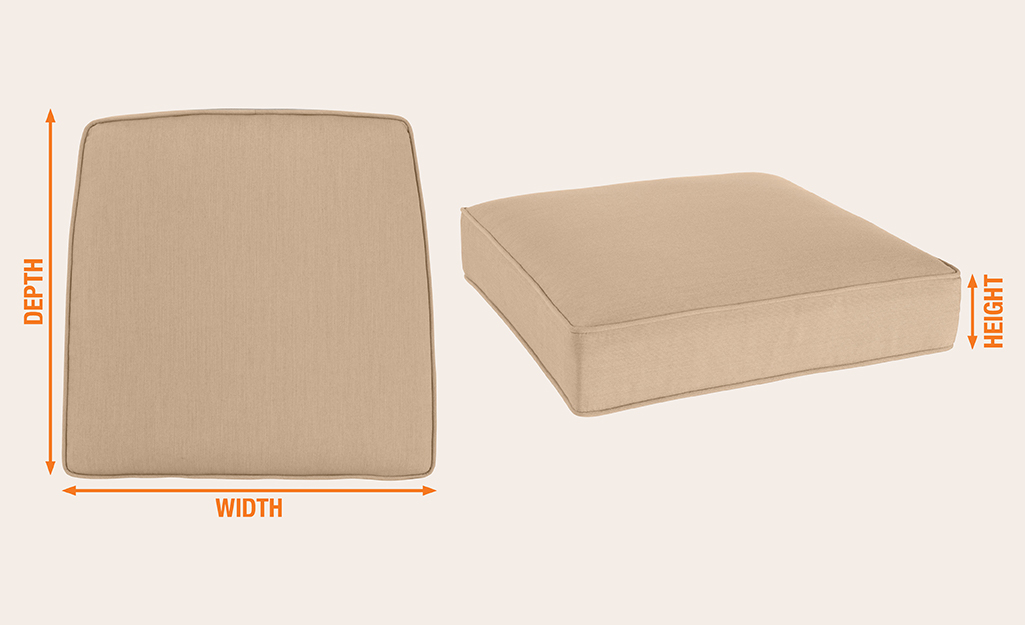
Image source: homedepot.com
Measuring Rounded, Wedge, and Corner Cushions
Odd shapes are easier to measure when you sketch first. Draw the rough shape on paper, then label every measurement so nothing gets lost in translation. For more on this, see our guide on how to clean sunbrella outdoor cushions.
- For a round cushion, measure the diameter through the center.
- For a semi-round cushion, measure the straight edge and the depth from the straight edge to the outer curve.
- For a wedge cushion, measure the long side, the short side, and the depth from front to back.
- For a corner cushion, measure each side length and, if possible, the angle between the two sides that meet the corner.
- For a tapered cushion, measure the top width, bottom width, and depth.
Use a flexible tape or a piece of string around curved edges. If the curve is unusual, place the cushion on a large sheet of paper and trace the outline. Measuring the tracing with a ruler is more reliable than trying to hold a tape against a round edge.

Image source: mybackyarddecor.com
Measure the Furniture Frame Too
Cushion dimensions are only half of the equation. The frame opening tells you whether the cushion will actually seat properly. It also helps you catch a sagging cushion that no longer reflects the true size.
Measure three parts of the frame:
- The width between the arms
- The depth from the front rail to the backrest
- The internal height or drop of the opening
For attached cushions, measure the seat area and the backrest area as two separate rectangles. For a bench or a sectional, measure every section individually. Modular pieces can differ by an inch even within the same set, so never assume one section is identical to another.
Keep frame measurements separate from cushion measurements. Mixing them is the fastest way to confuse a custom cushion maker.
Allowances, Seams, and How Much Extra to Add
After you have the basic dimensions, you often need to add a little extra for seams, zippers, and ease. This is where most people either overcorrect or undercorrect.
General starting points:
- Add 0.5 to 1 inch per side for sewn seams.
- Add about 1 inch total for a zippered cover that must pull over foam.
- Add 1 to 2 inches for a slip-on cover with a soft, compressible fill.
- For very firm foam, use less allowance so the cover stays snug.
Ask the vendor whether their sizes already include seam allowance. Many custom cushion makers build seam allowance into their pattern, so adding extra on top will make the cushion bulky. If the vendor does not include it, adding 1 inch to each dimension is a safe rule of thumb. It is easier to shave down a slightly large foam insert than to stretch a small one.
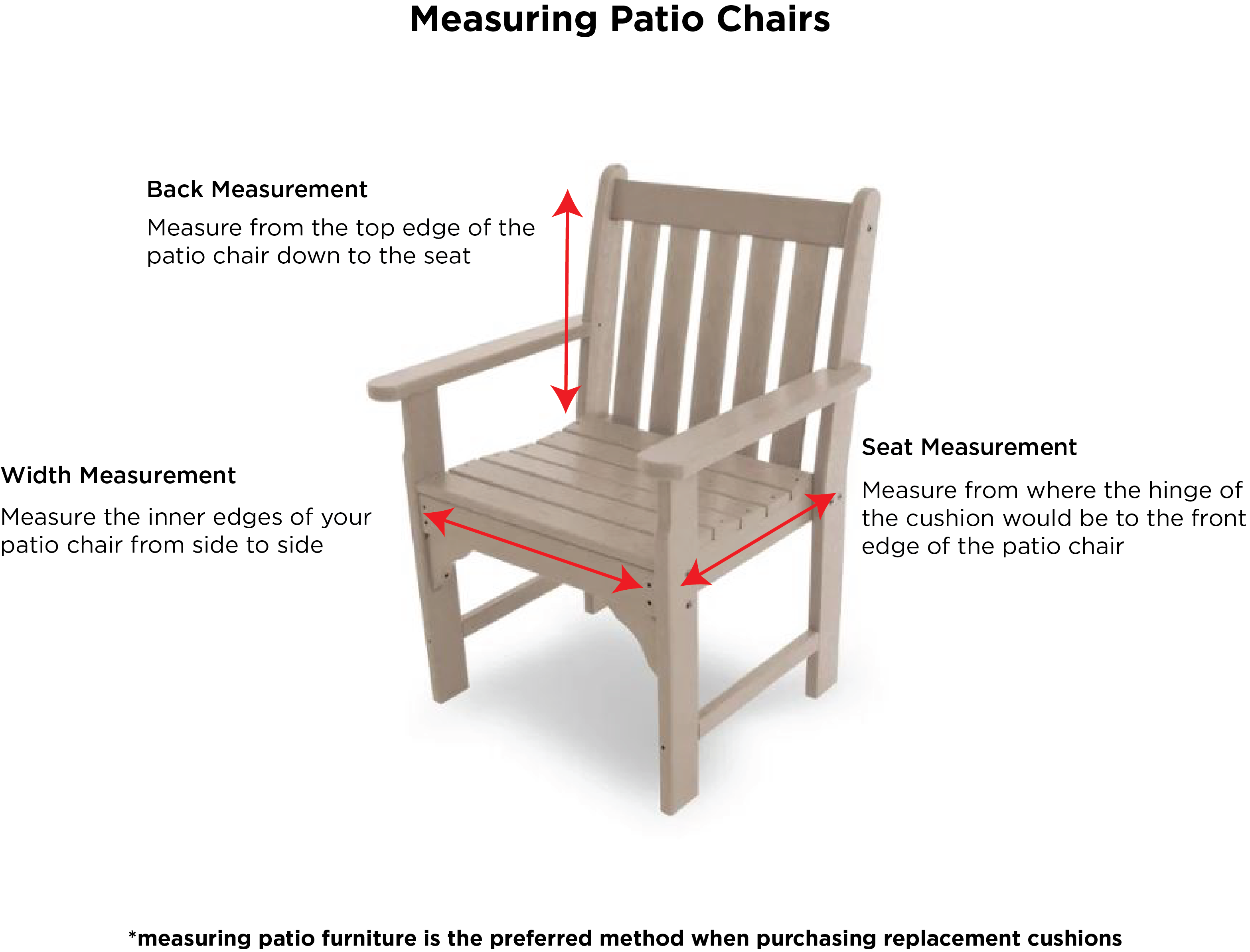
Image source: cushionconnection.com
Choosing Foam, Fill, and Thickness
Thickness is not just a visual preference. Most outdoor seat cushions are about 4 to 6 inches thick, while back cushions usually run 3 to 4 inches. Foam density matters more than raw thickness. A thick but low-density foam can flatten within one season, leaving you sitting on boards.
For outdoor use, choose:
- High-resilience, quick-dry foam
- Marine-grade or vented foam that lets water pass through
- Foam with a firmness suited to how the cushion will be used
- Polyester or down-wrapped fills only when you accept that they compress and need an extra inch of allowance
Indoor foam retains water, molds, and breaks down quickly outdoors. That is one reason I now check the foam type before I check the fabric color. Support materials behave in predictable ways, and understanding modern support layers makes it easier to choose a foam that will last more than a season.
How to Order Replacement Cushions
Ordering goes smoothly when you send the vendor a complete spec sheet. This is the checklist I use:
- Exact width, depth, and thickness for each cushion in inches
- A labeled sketch of any non-rectangular shape
- Foam type and firmness preference
- Fabric type, color, and the direction of any pattern
- Zipper placement, piping, flanges, and trim details
- Whether the price includes seam allowance
Ask for a confirmation drawing before production starts. If the vendor offers a sample or mock-up, order one for a large custom piece. Even if the website has its own size chart, compare your numbers to it before checkout. Two minutes of checking is faster than a return label.
Common Measuring Mistakes and How to Fix Them
| The Mistake | The Fix |
|---|---|
| Measuring over a rounded, stuffed edge | Pull the tape tight to the seam and measure flat |
| Measuring a cushion while it is still in the frame | Remove the cushion first; frames squeeze the foam |
| Copying an old cushion that has already sagged | Measure the frame opening as a second reference |
| Ignoring the gusset or flange | Write down every detail that changes the profile |
| Adding allowance when the maker already includes it | Ask the vendor explicitly |
The most expensive mistake I see is measuring a cushion while it is trapped between the arms of a chair. It may look like it fits, but once released, it can be far smaller than the opening. Always measure the cushion out of the frame, and always record the numbers in your phone before you forget them.
Care, Maintenance, and How Size Affects Longevity
A well-fitted cushion is also a longer-lasting cushion. A cover that is too tight stresses the zipper and seams. A cover that is too loose flaps in the wind, rubs against the frame, and wears through faster. A proper fit also lets water run off the surface instead of pooling in wrinkles.
For outdoor fabric, look for UV-resistant materials with some water repellency. Fabric performance is often measured against standards published by organizations such as ASTM International, so those labels are worth reading.
Moisture is the real enemy. A musty cushion is a mold problem, and the U.S. Environmental Protection Agency advises controlling moisture as the first defense against mold growth. If dust and dampness are already affecting your rest indoors, allergy-related sleep tips can help you spot similar problem spots in your bedroom.
Frequently Asked Questions
How do I measure a cushion that has a cover?
Remove the cover if it zips off and measure the foam core. If you cannot remove it, lay the cushion flat and measure from seam to seam. Do not pull the fabric tight over the middle of the cushion.
How much extra should I add for seams and zippers?
Start with 0.5 to 1 inch per side for seams and about 1 inch for a zippered cover. Then ask the vendor whether their listed dimensions already include seam allowance before you add anything.
Can I use indoor foam for outdoor cushions?
No. Indoor foam absorbs and holds water, which leads to mold, odor, and rapid breakdown. Use quick-dry or marine-grade foam for anything that will live outside.
How do I measure a circular or rounded cushion?
Measure the diameter through the center. For curved or irregular edges, use a flexible tape measure or trace the shape onto paper and measure the drawing.
Should I measure the furniture frame as well?
Yes. The frame gives you a second reference and helps you catch a cushion that has changed shape. Keep both sets of measurements separate.
What if my measurement is between sizes?
For firm foam, choose the slightly smaller size so the cover stays snug. For soft fill that compresses, choose the slightly larger size. If the gap is more than half an inch, ask the vendor whether a custom size is available.
Conclusion
Measuring an outdoor cushion is simple when you use the same order every time: width, depth, thickness, shape, and frame opening. Write the numbers down the same day, compare them with the vendor's size chart, and ask whether seam allowance is included.
Grab a flexible tape measure, start with the largest seat cushion, and record your measurements now. Do one cushion today, and the whole set becomes ten-minute work tomorrow. Browse our newer comfort guides for more ways to make every spot where you sit and sleep feel right.

Daniel Hart is a consumer product analyst who specializes in mattress technology, smart bedding, and home comfort innovation. Before joining Royal Comport, Daniel worked with several e-commerce research teams, testing and comparing sleep products for quality, value, and long-term performance. He brings data-driven insight and real-world testing to every review he writes.


