

A couch cushion that is a little too big or too small can make a whole sofa look off. The fabric sags, the foam shifts, and you end up sitting on a hard frame that was never meant to be felt. The fix is rarely complicated: accurate measurements. With one flexible tape measure, a few labels, and this easy accurate guide, you can measure couch cushions for covers, replacement foam, or custom cushions without the trial-and-error returns.
The basics sound simple — measure width, depth, and thickness — but the details matter. The best technique uses the seams, accounts for curved corners, and treats every cushion as its own shape. I have measured all sorts of sofas for re-upholstery and replacement work, and the same few steps keep coming back. Use this system once, and you will know exactly why a cushion fits or why it does not. For more on this, see our guide on how to clean couch cushions from pee.

Measure from seam to seam, not from the outer edge of the cushion, for a cover-ready result.
Image source: magiclinen.com
Why Accurate Couch Cushion Measurements Matter
A cushion that is too large stretches the cover and changes the way it wraps over the seat. A cushion that is too small slides around, looks sunken, and makes a sofa feel less supportive. When you are ordering something sight unseen, the whole job depends on the numbers you write down.
The same lesson applies to any place where support matters. A couch cushion is effectively a compact version of the support you rely on at night. Factors like firmness, depth, and how your body aligns on it all affect whether you can sit comfortably for hours. In fact, a poorly-sized cushion can add lower-back strain, making an evening on the sofa just as uncomfortable as a bad night’s sleep. For more on this, see our guide on how to clean feather couch cushions.
It is also worth taking the time to understand what proper support does for your spine overnight.
Another reason to measure carefully is financial. Cushion covers and custom foam inserts are not always cheap, and return shipping can be expensive. Measuring right the first time saves money, time, and the frustration of repacking a heavy cushion.
There is one more reason: consistency. Use one unit of measurement and write it down with that unit. Mixing inches and centimeters almost guarantees a mistake. Reliable physical measurement is the foundation of every well-made product, and the same principle matters at home. For more on this, see our guide on how to stop couch cushions from sliding.
Tools You Need to Measure Couch Cushions
You do not need a workshop full of equipment. In fact, most of the tools are probably already in your home.
- Flexible cloth tape measure – A soft tape follows curves and rounded corners better than a metal carpenter tape.
- Straightedge or ruler – handy for checking where the seam sits and for drawing straight reference lines.
- Pen and paper – write down every number immediately. The moment you walk away, memory gets unreliable.
- Masking tape – label cushions, mark seam points, and keep track of which cushion goes where.
- Phone camera – take reference photos of the zipper, seam placement, and the underside, especially for custom work.
- Clear floor space – place cushions on a flat surface whenever possible. This gives you more consistent readings than measuring while the cushion is still compressed between the arms.
A common mistake is using a stiff ruler on curved shapes. A soft tape follows the cushion smoothly and produces a dimension that matches the actual upholstery lines.
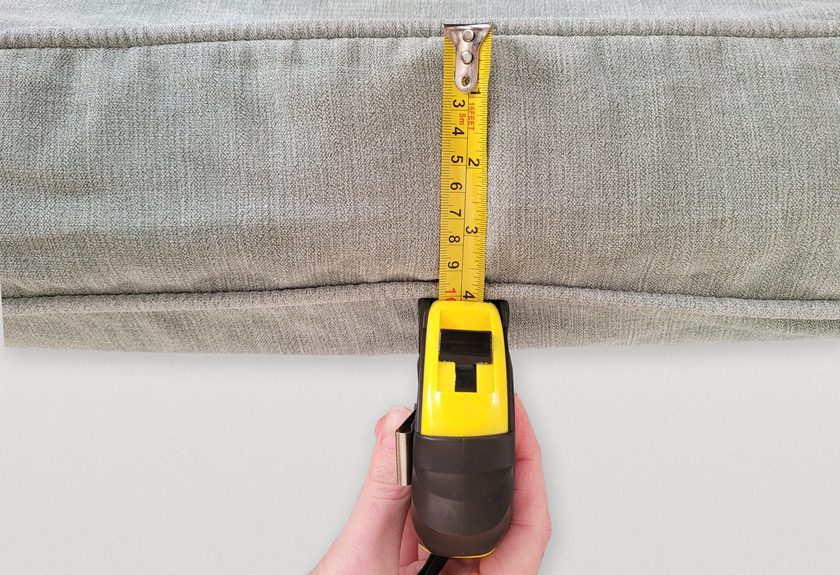
Image source: wecutfoam.co.uk
The Three Cushion Dimensions You Must Record
Three numbers cover most cushion sizes. Learn these terms first.
- Width – the distance across the cushion, measured from left to right at the widest seam-to-seam point.
- Depth – the front-to-back measurement, taken from the front outer seam to the back outer seam.
- Thickness – the height of the cushion, measured from the top surface down to the bottom seam.
The thickness is the most overlooked dimension. It is also the one that suffers most when elders choose a replacement cover. Many cushions are not uniformly thick: they puff up in the center and taper at the seam. That is why you should measure thickness in two places, center and edge, and record both. For more on this, see our guide on how to disinfect couch cushions.
You also want to note the shape. The seat cushion is a square-edge cushion, a box cushion, a knife-edge cushion with one seam around the sides, or a round/tapered treatment. The seam style updates cover measurements, so do not skip this observation.
How to Measure Seat Cushions Step-by-Step
Follow these steps for every separate seat cushion on the sofa.
- Take the cushion out if it is loose. A cushion removed from the frame gives a cleaner and more accurate dimension.
- Place it on a flat surface. Do not compress it with your weight.
- Smooth the fabric. Run your hands lightly over the cover so that wrinkles are not adding fake inches.
- Measure the width. Pull the tape from the left outer seam to the right outer seam. Keep it parallel to the front edge.
- Measure the depth. Run the tape from the front center seam to the back center seam.
- Measure the thickness at the center. Place the tape vertically and measure the highest part of the cushion.
- Measure the thickness at the edge. The edge is usually lower, especially on foam-filled cushions.
- Check the zipper. Note whether the zipper runs along the width, length, or around the sides. This is critical for covers.

Step-by-step in the order: width, depth, then center and edge thickness.
Image source: mbsr-montpellier.com
You should repeat these steps for every seat. Many sofas use multiple cushion sizes, especially on sectionals. Measure separately, and label each cushion before you take the next one.
What if the cushion is attached to the sofa?
If you cannot remove the cushion, measure the visible top area first. Then measure the frame depth behind the cushion so the cover can extend without pulling. Seam placement and hardware on the frame should be noted. Some attached cushions have a seam running into the sofa, so flexible tape is better than metal.
How to Measure Back Cushions and Loose Pillows
Back cushions come in different shapes, so they need a slightly different technique.
Loose back cushions
Remove the cushion and measure it like a seat cushion: width, height, and depth. For back cushions, the height is sometimes greater than the width, so make sure your notes clearly say which number is which.
Attached or semi-attached back cushions
Measure the exposed cushion area and the front profile of the frame behind it. If the shape is rounded rather than flat, write the largest height and the deepest curve point.
Box cushions and roll-top styles
- Box back cushions have distinct sides and a flat outer face. Measure all four sides and the thickness.
- Knife-edge back cushions are sewn with a thin edge. Measure the seam length and the arc thickness at the center of the pillow.
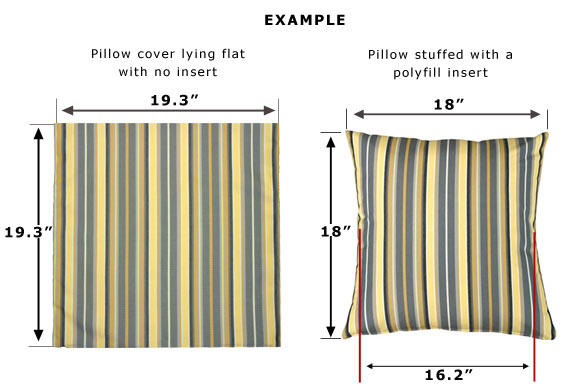
Loose back cushions use the same process, but mark the top and bottom so you do not flip them when ordering.
Image source: pillowdecor.com
A common mistake with loose back cushions is treating them as square rectangles. Many are lightly curved. Always measure at the widest visible point and write down if the curve is shallow or dramatic.
How to Measure Couch Cushions on Sectionals and Chaise Lounges
Sectional sofas are where measurement mistakes happen. The cushions are rarely the same size, and the frame pieces are tangled. A sectional cushion from the left side may not fit the right side at all.
- Label every seating position with letter stickers or masking tape before you remove anything.
- Measure each cushion separately even if they look identical.
- Pay extra attention at the connector joints. When the end of the sofa meets the chaise, the cushion may have a tapered end or a curved front.
- For a chaise lounge, measure the full depth of the bottom section, not just the visible flat part. The chaise is often longer than regular seats, and some heights turn near the arm.

Label positioning job before you measure for a chaise, so you never mix left and right cushions.
Image source: magiclinen.com
The labeling matters more than you think. In practice, almost every customer who has mixed up a pair of sectional cushions ended up with one loose fit and one tight fit. Labels like A, B, C, and a small arrow drawn on paper prevent that.
Measuring Rounded, Wedge, and Custom-Shaped Cushions
The standard width/depth measurements still count, but odd shapes need extra data.
Tips for curved cushions
- follow the curve with a flexible tape along the outer edge.
- Divide the shape into flat segments. Draw a rough sketch and then add each segment length to the sketch.
- The corner angle matters, not just the outside edges. Use a ruler or tape to approximate the inner and outer lengths.
- Write down the length of the seam lines that run around the curve.
Wedge cushions
Some sofas use wedge-shaped seat cushions that are wider at the front than the back. In this case, measure both front and back widths. Tape across the center too. That gives the maker the full trapezoid shape.
Deep curved backs
For rounded back cushions, measure the boxed structured side and the arc of the curve. The arc is the outside curve of the cushion, not the straight distance from the top to bottom. Use a flexible tape to follow the curve exactly.
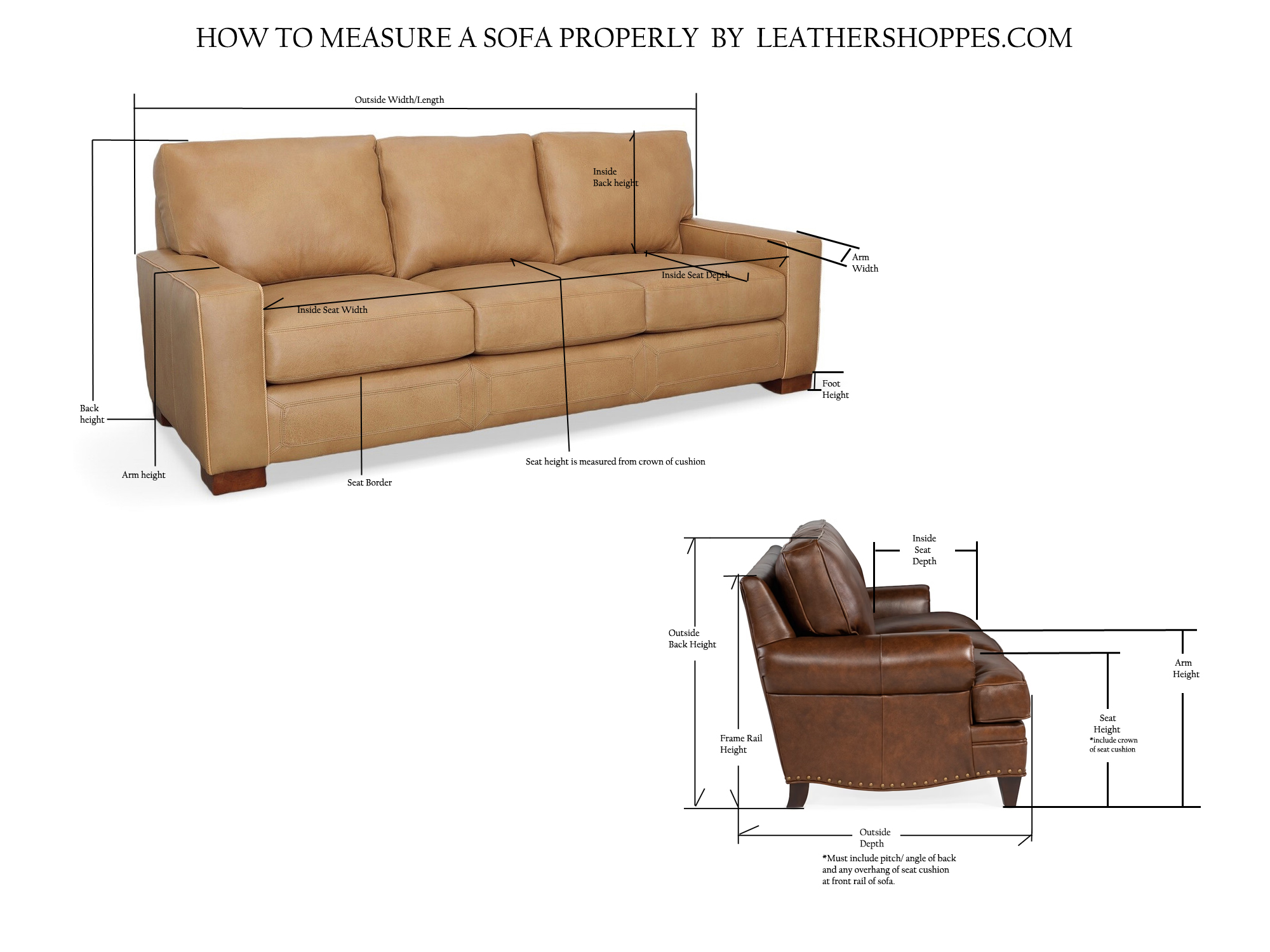
Image source: leathershoppes.com
When you have a custom shape, add a photograph or a hand sketch to your order. Photos do not replace measured numbers, but they help the maker understand what the numbers are doing.
Measuring Cushions for Replacement Foam or Inserts
Measuring for replacement foam is not exactly the same as measuring for a cover. The foam goes inside the upholstery, so you need the internal size and the right details about density.
Foam pieces: “cover-fit” vs “frame-fit”
There are two different sizes.
- The status of the cover envelope — remove the cover and measure inside where the foam sits.
- The final size of the replacement foam — the width, depth, and thickness of the raw foam.
A good rule of thumb is to subtracting 0.25 to 0.5 inch from the internal cover dimensions. Why? Foam is placed in it so that a foam that is actually the exact size of the cover will grip and form. A foam block 1 inch bigger than a cover will make a thick edge and bulge; a foam block 1 inch smaller gives support gaps.
Make these extra notes:
- Foam density – higher-density foam usually lasts longer on couches you use daily, while low-density foam may feel comfortable at first but soften quickly.
- Firmness/ILD rating – a foam supplier uses these gloves to describe how soft or firm the foam feels. If you are replacing a seat, do not choose the same thickness of foam if the firmness is lower.
- Compression – a common mistake is to fill the cover tightly. Most established foam cushions are intended to be slightly smaller so the cover stays smooth.
In practice, when you order replacement foam, you are essentially designing a new mini sleep surface. Many of the key concepts are the same.
Image along the guide position.
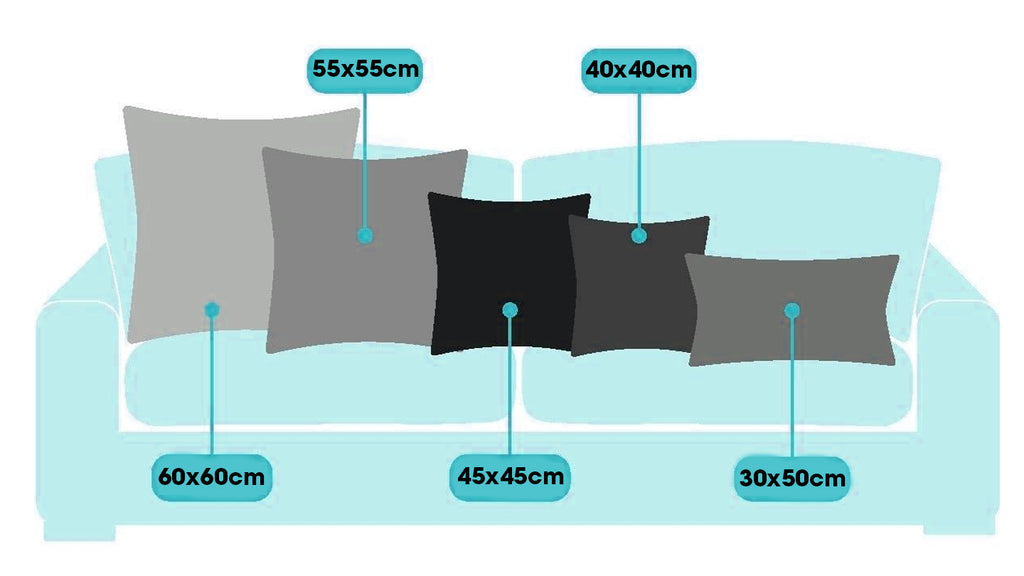
Use internal cover space, not the cover’s exterior, when you replace foam.
Image source: covermycushion.com
Measuring Cushions for Custom Slipcovers or Replacing Fabric
A bare cushion cover should fit the cushion snugly without stress. Measuring for a slipcover is therefore more about contour and seam line, not just the foam core.
Key steps:
- Measure the external cushion dimensions after the cushion is fully restored and fully firm. Do not compress it with your weight while measuring.
- Record the zipper – after installing the slipcover, can it run around the entire opening? A fixed end can need one parting direction.
- Check fabric stretch. A non-stretch fabric needs about 1 inch more in each side. In stretch, you often need little or no extra, because the material obeys the shape.
- Check the back and front drop – if the cushion sits within a frame, the slipcover may need to wrap around.
Slipcover mistakes often come from measuring the cushion before sealing the seams. Always smooth the seams outward before measuring. If the cover has thick piping, do not compress it with the tape.

A screenshot of a sofa; check the width and depth before ordering slipcover fabric.
Image source: youtube.com
Common Mistakes to Avoid When You Measure Couch Cushions
One cushioning size applied to all
Cushions on a sofa can be uneven, even when they look equal. Measure every cushion that needs a cover. Label it and keep its own set of numbers.
Not measuring the thickness at the edge
Many casual measurements only use the center point. An edge that is lower or level in height makes the cover look saggy. The quick fix is to record center and edge inches.
Ignoring seam and zipper placement
The cover may be 1 exact inch, but if the zipper is on the wrong side, you cannot install it. Note zipper route for each cushion.
Saying no to the couch’s fabric
Worn, loose, or packing fabric changes the cover fit. If the fill takes up the cover space, worn fabric of the old cushion will measure differently.
Nonlinear measurements
Pull the tape comfortably taut but do not stretch it. For a soft cloth tape, stretching can easily remove half an inch. Use a flexible tape but check a line on the floor or table for extra accuracy.
Still trusting “standard sofa cushion size”
There is no universal standard that works for every sofa, and curiosities are today are even less predictable. Numbers from your own tape, dated now, always beat the average from a catalogue.
Sizing Cheat Sheet and Quick Reference
Use this table as a starting point, but remember that real dimensions vary by sofa and manufacturer.
| Dimension | Typical adult sofa range | How to record it |
|---|---|---|
| Seat cushion width | 20–30 in (0.5–0.8 cm) | 1 2" |
| Seat cushion depth | 18–24 in (0.5–0.6 m) | 2 1" |
| Cushion thickness | 3–8 in (8–20 cm) | 4" center / 3" edge |
| Back cushion width | 18–28 in (0.5–0.7 m) | 2 1" |
| Throw pillow | 16×16 in, 18×18 in, 20×20 in | 18×18" |
Use one consistent unit when you write it down. If you buy a cover from an internationale maker, include both inches and centimeters only if the supplier asks. The system that matters is the one used on the maker’s sizing page.
Small Habits for Clean, Useful Records
Good records save more returns than any other finding.
Label each cushion with a single letter: A, B, C, and the matching tape on the sofa.
Write the measurements original with the date.
Take a photo of each cushion with the measuring tape still in sight.
Store all notes in a folder, a note, or a spreadsheetso the numbers survive until the next time you need them.
Use the same tape measure for every cushion. Two different tapes can disagree by a fraction of an inch — just enough to ruin a tight-fitting cover.
Round to the nearest quarter inch (or half centimeter) and stick with one unit. Never switch between inches and centimeters in the same set of notes.
Re-measure right before you order. Foam settles, covers stretch, and the numbers you took six months ago are no longer trustworthy.
In practice, the people who never need to return a cover are the ones who treat measuring like a ritual. They smooth the fabric, use the same tape, and write the numbers down immediately. A reliable result comes from repeatable technique, not lucky hands. That is the same principle behind repeatable measurement practices at national laboratories and manufacturing plants: consistency beats a single well-judged read.
Measuring for Bench, Window Seat, and Outdoor Cushions
Most of this guide assumes you are measuring a sofa, but the same method extends to any rectangular seat cushion. Bench and window seat cushions are usually thinner than sofa seats yet wider, so the three numbers that matter are still width, depth, and thickness. Add a few extra checks:
- Measure the inside width of the bench or window frame at the left, center, and right. Frames are rarely perfectly square.
- Leave a 0.25 to 0.5 inch gap between the cushion edge and the frame so the cushion can be lifted out easily.
- For outdoor cushions, measure when the cushion is completely dry. Water trapped in the fabric or foam can distort the size.
Think about how the cushion will be used before you choose a thickness. A deep bench where people actually sit needs more support than a decorative window seat that just makes a room look finished. This is no different from choosing a mattress by body type: most people start by identifying what their body actually needs before they test anything.
Frequently Asked Questions About Measuring Couch Cushions
How do I measure a cushion that is attached to the couch?
Measure the visible seam-to-seam width and depth across the top, then slip the tape between the cushion and the frame to record the recessed area behind it. Write down the zipper location and whether the seam connects directly to the sofa frame. If the cushion is sagging rather than just worn on the surface, fixing sagging cushions is often a faster, cheaper project than replacing the entire cushion.
Should I measure cushions while they are on the couch?
Removing the cushion gives the most honest numbers because the foam is free to expand to its natural shape. If the cushion is fixed in place, measure the visible surface, smooth the fabric first, and then add the hidden frame gap to the depth. Mention in your notes that the cushion was attached when measured, so the maker can adjust the pattern accordingly.
How much extra room should I allow for slipcovers?
For non-stretch fabrics, start with 1 inch added to the width and depth and 0.5 inch added to the thickness. For stretch fabrics, add just 0 to 0.5 inch in every direction. If the cushion is unusually plump or heavily rounded, add 1 to 2 inches to the height. The most reliable step is to check the maker's own sizing chart, because that chart already accounts for how that specific fabric behaves.
Can I use the same measurements for replacement foam?
No. Use the internal cover dimensions, not the outer cushion size. Remove the cover, measure the inner seam-to-seam space where the foam sits, and subtract 0.25 to 0.5 inch so the foam sits snugly without bulging. For thickness, measure the old foam core itself, not the cover. Also confirm density and firmness: foam suppliers describe these values using flexible foam test methods published by standards bodies such as ASTM International. The same logic applies at full mattress scale — once you understand a product's support core details, it is far easier to predict how it will feel under your weight.
What if my cushion has rounded corners or curved edges?
Use a flexible tape to follow the curve, then record the straight-line width and depth at the widest points. Draw a small sketch of the shape, note the arc length along the curve, and photograph it with the tape still in view. Include the depth of the curve at its deepest point — that single detail lets a maker reproduce an exact insert.
Conclusion
Measuring cushions properly is not about being obsessive. It is about giving any cover maker, foam supplier, or upholsterer the few numbers they need to do a better job. Take the width seam to seam, the depth front to back, and the thickness at both the center and the edge. Write down zipper placement, seam position, and cushion shape, then label every cushion and keep the notes where you can find them again.
Before you click "order," take five minutes to measure every cushion — not just the one on top. Snap a labelled photo, save it to your phone, and you will never gamble on whether a cover fits. One accurate measurement is the difference between a custom-looking fit and a return label.
The same honest assessment belongs in your bedroom. If your mattress is as tired as your sofa cushions, improving your nightly rest starts with the same approach: measure what you have, note what is worn, and replace only what is genuinely past its useful life.
Sometimes that means a new 4-inch foam insert; sometimes it means a completely different sleeping surface. Either way, the goal is the same — a comfortable night's sleep that does not depend on luck.
Start with the cushion you are sitting on right now. Measure it, photograph it, and see whether it matches the size you assumed. That one small check will tell you more about your sofa than any catalogue photo ever will.

Daniel Hart is a consumer product analyst who specializes in mattress technology, smart bedding, and home comfort innovation. Before joining Royal Comport, Daniel worked with several e-commerce research teams, testing and comparing sleep products for quality, value, and long-term performance. He brings data-driven insight and real-world testing to every review he writes.


